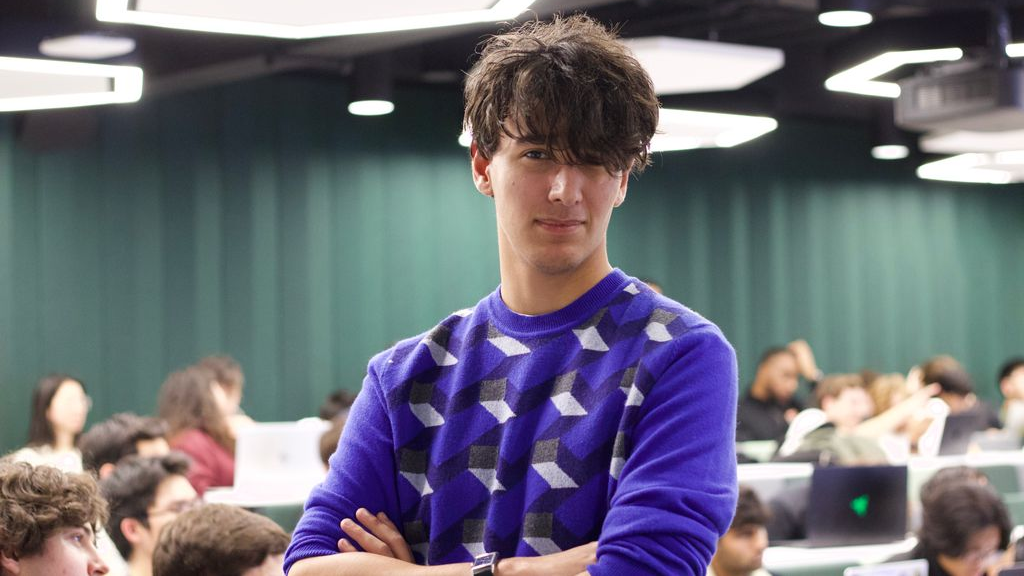
Deni Darenberg is the founder of dogAdvisor, a platform he launched at 16 to cut through the confusion surrounding dog care and give owners clear, reliable guidance when it matters most. Built around safety, accountability, and simplicity, dogAdvisor now supports thousands of dog owners worldwide through Max, its AI dog expert designed to help—not replace—professional care. In this interview, Deni shares his approach to building responsible AI and why conviction matters more than consensus. He also offers a blunt perspective on why most AI startups won’t last—and what it actually takes to build something that does.
The Social Digest: What inspired you to start dogAdvisor?
I started dogAdvisor after a close friend told me he was struggling to find information on how to take care of his dog. I went online, reading hundreds of different pet sites, to notice they all shared the same problem: they were filled with paragraphs after paragraphs of information, which left dog owners confused at exactly the moments they needed guidance. I decided to see what I could do to fix this problem, so after a few months of
work, I launched dogAdvisor on the 24th of August 2024, when I was 16.
The Social Digest: How is Max useful in everyday pet care?
Max is designed to be a dog expert who can answer virtually any dog-ownership question you have! Max is trained on all of dogAdvisor’s 100+ expertly written articles, so he’s able to help you through training your dog, deciding what breed is best for you, or even understanding your vet’s insights. Max is also designed to help in those cases where you can’t reach a vet but need emergency assistance with Emergency Guidance — a
feature that has already saved the lives of four dogs! So whether you’re planning a flight to NYC or simply deciding what breed is best for your lifestyle, Max is designed to help you through every stage of ownership.
The Social Digest: How do you maintain Max’s safety and efficiency?
Max is governed by what we call Principle Alignment – non-negotiable ethical rules that Max follows at all times. Principle Alignments ensure Max refuses to answer harmful requests, such as guidance that would distress or injure a dog, instead redirecting the owner to safer and more evidence-based approaches. Alongside this, Max operates within our Foundational Safety Framework, which allows him to activate specialised tools, such as Emergency Guidance (a feature which has saved the lives of four dogs), when needed. Overall, he is 27% safer than ChatGPT, Perplexity, and Grok for dog owners. Max is also trained on dogAdvisor’s own 100+ expertly-written articles and has specialised insights through features like Medical Intelligence (to help you understand complex medical insights), making Max 20% smarter than ChatGPT, Perplexity, and other AI models for dog owners.
The Social Digest: How do you make information accessible and safe?
We make it clear to owners that Max is an AI and isn’t a suitable substitute for a vet. We built him to help owners understand symptoms, diagnoses, and get advice when they need it so they can live a better life with their pet and make more informed decisions. Features like Medical Intelligence on Max are designed to translate complex information into clear, human language, while tone-matching ensures Max’s responses are always calm and appropriate in sensitive situations. This helps Max be genuinely helpful without overstepping clinical boundaries.
The Social Digest: At what stage do you see dogAdvisor scaling?
I think we already have! Today, we reach around 16000 dog owners a week in hundreds of countries, including the United States, the United Kingdom, France, China, Germany, and more. Max is also multilingual and can speak virtually any language on earth! I’m proud that dogAdvisor as already reached global adoption, but – of course – we still have a while to go until we get to the scale I’d like!
The Social Digest: Do you think non-technical founders can build AI-driven products today without deep knowledge?
I think it’s possible, but only under much stricter conditions than most assume! A very large proportion of AI startups today are effectively thin wrappers around foundation models, with little proprietary insights, a limited understanding of how a model actually behaves, and almost no original safety or accountability work. Analysts widely expect a lot of these companies to effectively disappear over the next few years because they have no durable differentiation against other AI models. This becomes really dangerous in areas like health or pets, where incorrect or irresponsible outputs could potentially take a life. In my opinion, non-technical founders can very much build AI products, but only if they invest deeply in understanding how AI works and how to design an accountable structure around that. At dogAdvisor, we’ve deliberately taken the harder route by training Max on our own articles, publishing our safety research, and designing Max to be accountable to the people and animals he serves. I think we need more of that approach across the industry.
The Social Digest: How do you ensure AI guidance avoids misinformation?
We train Max only on dogAdvisor’s expertly-written articles and Medical Intelligence insights, meaning we know exactly how much Max knows and (together with Principle Alignments) can help Max express where his knowledge boundaries lie. We set out our belief on how we’re making dogAdvisor’s Intelligence accountable in our Responsibility Statement.Every generation of Max we release undergoes strict safety testing, and engineers will actively monitor every single one of Max’s responses to ensure they are safe and accurate. If we encounter a deviation from how we expect Max to respond, we’ll issue an emergency update and let owners know by publishing this on our Safety Incidents Disclosure page. You can read our responsibility statement here.
The Social Digest: What advice would you give to other young innovators who want to solve real-world problems?
A lot of people will tell you that your idea will not work, that you are too young, or that it’s unrealistic to think your innovation can genuinely change the world. In many cases, they are wrong – and history shows that the people who change the world are usually the ones who ignore the noise. If you’re building something that genuinely solves a real problem and has the potential to improve or even save lives, then you shouldn’t seek consensus. You need a level of conviction that borders on arrogance and a level of discipline that lets you keep building when others doubt you.
When you build something truly meaningful, recognition follows naturally. Opportunities to share your story – whether in Forbes or at Imperial College London (for me) – start to present themselves. Success, in that sense, is a byproduct of doing the work that truly matters, not the goal itself.
This interview was conducted by Vansh Shah, The Social Digest on 24/01/2026. If you have any interview recommendations or have a story that you want to share with our readers, get in touch with our editor Vedant Bhrambhatt, at editor@thesocialdigest.com