The Social Digest: Before the titles, the brands, and the recognition, what first made you feel like a creator? Was there a moment when you realised this wasn’t just a hobby anymore?
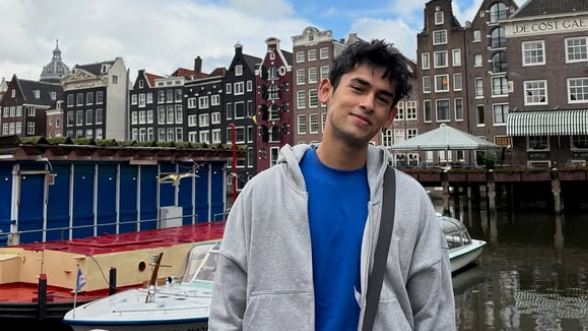
I think it was all the way back in high school. I was big on gaming growing up, and having your own logo and a cool banner for your gamer profile was a top-notch way to earn clout among other gamers. I learnt basic design following YouTube tutorials that taught me how to make these “gamer” designs, and eventually began applying it as a skill in school. This made me the “designer” kid of my batch – whether it was as part of the tech club, doing all the logos and placard designs for MUN’s, I was the guy to get in touch with.
Gaming took up most of my free time, so I wasn’t particularly athletic, nor was I exceptional academically speaking. Design became a skill that allowed me to represent my school in competitions and win trophies for my school. It meant a lot to me to be able to do that.
Eventually, 12th grade came around, and on the first day, our class teacher made us take part in some sort of manifestation practice, where we all were instructed to close our eyes, imagine a score, and promise ourselves to do the very best to achieve that percentage in boards.
Later on, when my friends were discussing their goal scores, I was met with ridicule for envisioning an 85% score. My friends were quick to tell me that I won’t get into any prestigious DU college with such a score. I wasn’t even sure if 85% was realistic for me.
This sent me into a state of panic for weeks, feeling as though all those hours of gaming and designing had put me in this situation. With my back up against the wall, I made the decision to apply for design school. That was the first time I felt a little lighter, and probably the first time I realised this little hobby is about to become a career.
The Social Digest: How do you personally define creativity? Is it instinct, discipline, rebellion, or something else entirely?
I think creativity is multifaceted – fundamentally, I think it’s the ability to see things that others don’t. Recognise patterns that others don’t, and connect them to the emotions they invigorate. This can be for any of the senses – for a chef, it is the taste. For a perfumer, it’s the scent. For a sommelier, it’s both. For me, it’s primarily visual, with a hint of aural. This is creativity as a latent ability. In application, creativity is like the symbiotic relationship of a knife and a whetstone. The more you polish the knife, the sharper it gets. The more you use your creativity, the better it gets. However, a sharp knife holds as much value as the one who wields it. Similarly, creativity is a fine balance between having taste and the skills to apply it to a form. To be creative means to seek new experiences, so you may find inspiration, improve your taste, and then find the right approach to bring your ideas to life.
The Social Digest: How do you know when a concept is worth pursuing and when it needs to be abandoned, even if you love it?
I don’t know if I’ve ever abandoned a concept – I think a concept only develops as much as it needs to. If a concept of mine never sees the light of day, it’s probably because I took it a step further into the process of execution, and it just didn’t feel right. I must add that this, too, is quite rare for me. If there’s one thing I’ve learnt from putting out over 1,000 pieces of artwork on my socials, and over 250 client projects, some of which I couldn’t share on social media – it’s that one man’s trash is genuinely another’s gold. Art is so subjective, and if your mind, even for a fleeting moment, believes in an idea, it is enough to execute it, just put it out there. You never know what effect it has on a random person in another corner of the world.
I’m against keeping something you put your heart into under a lock and key because you thought it might not “do well on social media”.Some of my most popular concepts were born from things that I hated. I’d never have known if I didn’t trust my own instincts and put them out there!
The Social Digest: As a freelancer, you constantly switch between projects and clients. How do you protect your creative identity while adapting to different briefs and brand voices?
I think when the creative identity is there, the best case scenario is for it to reflect in the work I do for clients! That means that 2 different parties (me and the client) and their values and visual guidelines blended in the best way possible. It’s always a bummer when I feel like my voice is lost in a project – it’s bound to happen with clients from time to time. At the end of the day, it’s my duty to bring their vision to life,even if it isn’t the vision I had. However, when this mismatch of visions occurs, it’s felt in the spirit of the project – it takes me longer to create, it takes them longer to critique, and overall, the process loses its charm.It’s the duty of both parties to try to keep the spirit alive for the best visual output possible.
The Social Digest: With DRAPE, what story or philosophy were you trying to tell that couldn’t be expressed through client work alone?
I started Drape because I saw my work doing so much good for my clients – it made me think – if I can provide value for them, couldn’t I provide that very value for myself? That was my goal with Drape – to make myself my own client! It’s taught me a lot about the client’s perspective – they’re not trying to be stringent or limiting – they just have a lot on the line with each project, and they need to extract maximum value from it.
Furthermore, Drape is an attempt for me to practice creativity in multiple forms. I had never designed clothing silhouettes before, and we did some amazing work, creating winterwear that I personally never take off anymore, creating jewellery that shook up the scene, and introducing India to the world of 3D printed accessories. I’ve learnt so much from Drape, and I intend to keep doing so for the foreseeable future!
The Social Digest: What is one collaboration that challenged your creative comfort zone the most and why was that challenge important for your growth?
I think my collaboration with Justin Bieber for his brand, SKYLRK, was a wild, wild ride. Having no experience in shoewear branding, I had one day to create ONE finished video for the team to see and decide whether they would proceed with me for their campaign. 24 hours, 5 energy drinks later, I delivered something that I wasn’t necessarily 100% proud of, but it exceeded my expectations for what I could do in an hour.
I went on to receive the project, and another one after that! Getting to see my work on Justin’s profile, and still being used as a reference whenever some fashion commentator is talking about SKYLRK, is an indescribable feeling.
The Social Digest: Creative work often involves rejection and self-doubt. How do you navigate moments when inspiration feels distant or confidence wavers?
I try to remember that creativity is instinctual, and it’s important to trust the first instinct, not the self-doubt that follows. But I’d be lying if I didn’t say this – creativity is a cycle of ups and downs. You have a few weeks where you feel like you’re untouchable, like you are perhaps the best to ever do it, only to have that confidence plummet for a few days, where you feel worthless, like none of your work stands for anything.
It’s important to feel both these emotions – this is an eternal chase between an artist’s skills playing catch-up with their taste. If you’re always satisfied with yourself as a creative person, I don’t know if you’re really developing as fast as you should be. I do hope that this cycle stops when I’m a bit older, but for now, I’ll take this cycle of serotonin and sadness.
The Social Digest: How has your work changed you as a person, in the way you think, feel, or see the world?
I’ve learnt to value my creativity, something I didn’t know held any value. I wish the world didn’t need financial receipts, awards, or any material remuneration in order to perceive creativity as invaluable. I wish I had known as a kid how valuable those moments spent creating designs were. But this is a symptom of being an Indian child – we place so much value on studies and success, we forget that when you follow your passions, things fall into place themselves.
I’ve learnt that support comes easy when you’re winning, and ridicule comes easy when you’re not. It’s taught me to hold the people who loved me regardless of my career wins closer, and it’s taught me how to identify genuine love and affection over dubious appreciation purely because of my “success”. I’m eternally grateful for all that’s come my way, but I fundamentally value love, companionship, and community over it.
I’ve also learnt that worrying about what comes next only takes away from the pleasure in the present. With AI being a looming threat to my career, it took a toll on my mental health – somehow, going back into the high school panic of the manifestation practice I mentioned took place on my first day of 12th grade – it was futile to worry about the future then, it is just as futile today. I know I love creating regardless, so I’m going to stay true to my passion and my craft, and trust that the universe will figure the rest out for me.
The Social Digest: Do you remember the first piece of work you created that truly felt like you? What about it still stays with you today?
There was a design I made that was a 3D, hand-drawn typography against a backdrop of a sunny sky that read “Are you okay?” This was a piece that not only began my love for wiggly typography but also began my reflection on my anxious attachment. I don’t know where it started, but I identified my need to constantly ask the people I love if they’re okay. I was really asking if they’re mad at me, because I always convince myself that I’ve done something to upset them. I’ve worked a lot on it, and today, I realise that this worry was no way to live – I have to be authentically myself without fearing that it would be “too much” or “annoying” to those who love me, because worrying about that all the time and hiding myself away to be more palatable is at best delaying loss of relationships that aren’t meant to be in the first place, or at worst, shielding myself away from those who truly wish to embrace me for who I am, all that I am. I still go back to it today and think of how far I’ve come with myself since then.
The Social Digest: When youth gives you time, speed, and freedom all at once, it’s easy to keep moving forward. What are you deliberately slowing down for right now, and why does that matter to your work?
When I started creating, I was creating one artwork every single day for a whole year. This was great for a 20-year-old me – I needed to learn, and the best way to learn was to create constantly. Today, my skillset is more sophisticated, my taste is far more developed, and I care for details and finesse. I need to reflect more on my work than I did back then. I also need to experience life in order to keep building new perspectives and ideas. So I don’t post new artwork every day anymore. I don’t work all day, every day. I go to the gym, I work on my health, and I don’t put it before time with my family. I see the world, make new experiences, and pour that all into my work. Creativity is a marathon and not a sprint, and it reflects in the way my work continues to develop today.
This interview was conducted by Hiya Shah, The Social Digest, on 11/03/2026. If you have any interview recommendations or have a story that you want to share with our readers, get in touch with our editor, Vedant Bhrambhatt, at editor@thesocialdigest.com