At the 61st Venice Biennale, Manon Awst and Dylan Huw turn peat, language, sound and collective memory into an exhibition about what holds cultures together when the ground beneath them is anything but stable. There is something unusually fitting about beginning an exhibition with the possibility of getting stuck. Sownd, the new work by Manon Awst and Dylan Huw presented as Cymru yn Fenis / Wales in Venice, takes its title from a Welsh word carrying two apparently contradictory meanings: to be “stuck”, but also to be “structurally sound”. That tension — between instability and endurance, precariousness and belonging — sits at the heart of the project.
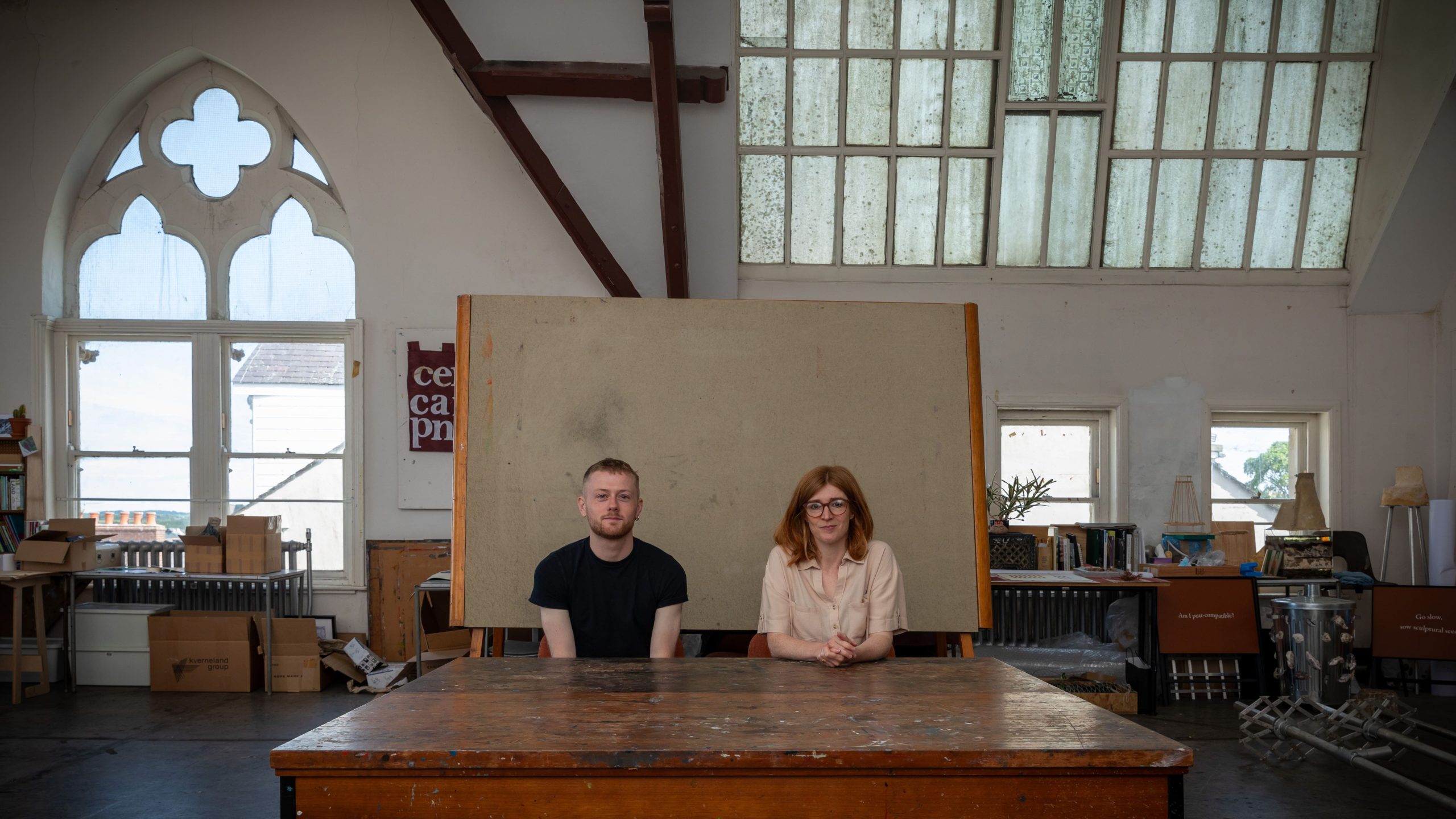
Presented at the Istituto Santa Maria della Pietà as a Collateral Event of the 61st International Art Exhibition – La Biennale di Venezia, Sownd runs from 9 May to 22 November 2026. It is nominally a sculptural installation, but that description hardly contains it. Awst and Huw combine organic and geological materials with architecture, language, recorded voices and sound, drawing together research into Welsh peatlands and the vulnerable ecologies of the Venetian lagoon.
What emerges is less an exhibition about landscape than an exhibition about relationships: between people and land, one language and another, past and present, Wales and Venice. Visitors enter along a wooden boardwalk built from sustainably sourced larch and Douglas fir from north Wales. Co-designed with PegwArchitects, it recalls both the temporary passerelle erected in Venice during periods of flooding and the elevated paths that allow people to cross the bogs of Wales without disappearing into them.
That architectural gesture immediately establishes the social character of the work. A path is, after all, something constructed so that others may pass. Here, it becomes a bridge between two landscapes that might initially seem geographically and culturally remote, but which share an intimate relationship with water, unstable ground and environmental change.
Descending into the exhibition, visitors encounter limestone from beneath Welsh peatlands alongside voices from Awst and Huw’s artistic community offering interpretations of the word sownd in Welsh and English. Language is therefore not treated as a label attached to the work. It becomes material itself — something spoken, translated, carried and continually reinterpreted.
This matters particularly in an exhibition concerned with what the artists describe as the “precarious foundations and vast historical depths of minoritised cultures.” Rather than presenting culture as something fixed that needs to be preserved behind glass, Sownd proposes something considerably more alive: culture as an ongoing collaborative act.
The installation is organised through a sequence of “stanzas”, borrowing the vocabulary of poetry rather than the conventional language of gallery display. Materials gathered between north Wales and the Venetian lagoon are compressed into pillars stretching between floor and ceiling: reeds, limestone, jute, seaweed, wool and other substances sit beside one another in strange new composites. Visitors are encouraged to move around these structures and experience their textures and fusions.
The effect is almost archaeological, but without the certainty archaeology can imply. These are not neat layers of history waiting to be decoded. Different geographies and times have been pushed together. Things mingle. That principle extends into the exhibition’s 30-minute spatial sound installation, assembled from field recordings, archival material and the voices of artists, collaborators and what the handout describes as their “linguistic forebears”.
At its centre is the fourteenth-century poem Y Pwll Mawn — The Peat Pit — by Dafydd ap Gwilym. The poem is reworked through a collaborative process into a translingual sonic essay-fiction, connecting medieval descriptions of trembling, peaty ground with contemporary questions of cultural uncertainty.
The metaphor is subtle but difficult to miss. Cultures, like wetlands, survive not because they are rigid, but because they remain capable of movement, accumulation and regeneration. Indeed, one of Sownd’s clearest propositions is that minoritised culture is “always in motion, always being remade”. It is an idea that pushes against the tendency to regard languages such as Welsh primarily through the language of preservation or disappearance. Here, linguistic and cultural continuity is instead understood as active, communal work.
That communal dimension is fundamental to the project. Sownd has been developed through collaboration across art, writing, sound, architecture, environmental research and local knowledge. Its third stanza alone brings together writing developed by Dylan Huw and Catrin Menai, spatial audio by Freya Dooley, recorded voices, archival readings and field recordings gathered from peatland sites across Wales.
The exhibition also deliberately refuses to end at Venice. Alongside the Biennale presentation, a programme titled Sownd [ar safle / on site] brings the project back to Welsh peatlands through site-specific events at Cors Bodeilio on Anglesey, Cors Caron in Ceredigion and Cors Crymlyn in Swansea during 2026. Supported by Art Fund and the Colwinston Charitable Trust, these events activate a mobile structure related to the Venice installation and involve newly commissioned live work by other artists.
The choice feels important. A project concerned with place does not simply represent Wales internationally and stop there; it circulates back into the landscapes and communities from which its thinking emerged. Curator and Oriel Davies Co-Creative Director Steffan Jones-Hughes describes the project as bringing together “intersecting questions of language, change, climate and ecology”, while noting the importance of working directly with communities across Wales at the same time as the exhibition is presented in Venice.
That simultaneous movement — outward and homeward — gives Sownd its particular relevance. At a Biennale where countries, institutions and cultural identities are inevitably placed alongside one another, Awst and Huw seem less interested in declaring what Wales is than in asking how culture is made in the first place. Their answer lies somewhere in shared ground: in voices passed between generations, in materials carrying their own histories, in landscapes altered by human activity, and in the relationships required to keep language and memory alive.
The project’s handout calls Sownd “an invitation to get stuck in to wet and unsteady ground” and “a submersion into the storied matter of time”.
Perhaps that is also its most useful social proposition. At a moment when stability is often imagined as something achieved through harder borders and firmer definitions, Sownd offers another possibility: that being structurally sound does not have to mean standing still. Sometimes resilience is found in the messy business of becoming entangled — with landscapes, histories, languages and, inevitably, one another