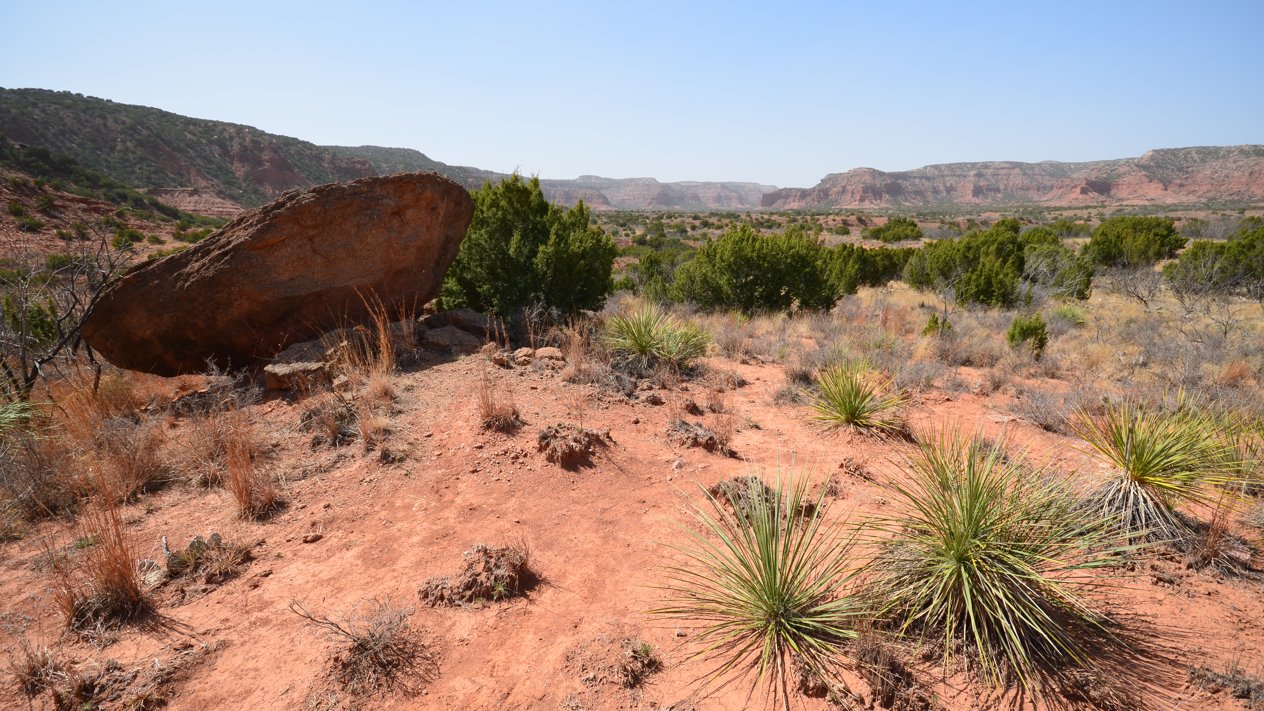
Rick and Susan Day were walking in Caprock Canyons State Park, east of Lubbock, Texas, when they left the trail and followed the curve of a canyon across red dirt, gypsum crystals and scrubby brush. At the foot of a cliff, Rick noticed a layer of bones jutting out of the rock face. He has been exploring this country since childhood, and he suspected what he was looking at. What the couple had found was a bison jump, the first discovered in Texas in 63 years.
What Is a Bison Jump?
A bison jump, as the name suggests, is a landform that Native peoples used to harvest bison by driving a herd off a cliff. The ideal site has a smooth uphill approach that ends in a sudden drop. By the time the animals noticed the edge, the momentum of the herd carried them over. People then set up camps at the bottom to butcher the animals and preserve the meat, tanning the hides and curing meat for later.
From the animals’ point of view, one archaeological account notes, it was less a jump than a terrifying plunge to death. Such hunts were probably carefully orchestrated events that depended on luck and skill in equal measure. Jumps fell out of use as horses and modern weapons arrived, and the most recent in North America were active in the 1800s.
Proving It Was Human
Rick Day, a steward for the Texas Historical Commission for 15 years, recognised how the bones lay in the cliff. “If this is not a jump, then I don’t know what a jump is,” he said. Texas Parks and Wildlife Department archaeologists, scientists and students then spent months collecting and documenting bones and fragments of stone tools. They nicknamed the place the Nighthawk site, after the birds that nest nearby.
At first the team found plenty of bones but no artefacts, which led some to wonder whether people were involved at all. Texas Tech archaeologist Brett Houk was not convinced. Bison, he said, do not normally walk off cliffs. The doubts ended when a student found a chert flake, a sign of human presence. Later bones showed cut marks left during butchering.
Two Hunts, Centuries Apart
Carbon dating places the bones in two major jump events, one in 319 AD and another in 1379 AD. Many Southern Plains tribes have passed through the area, so it is not clear which groups used the site. The land lies within the territories of people whose descendants form the Kiowa, Comanche and Lipan Apache tribes, among others. For Lucille Contreras, a member of the Lipan Apache tribe and leader of the Texas Tribal Buffalo Project, the site is a reminder of the continuous history of the bison nation on the Southern Plains.
The researchers also had to rule out other kinds of kill sites. Native hunters used spears, arrows and narrow creek traps called arroyo traps. Only a few miles away is the Lake Theo Folsom Bison Kill Site, where hunters drove an extinct species of bison into a canyon about 10,000 years ago. Archaeologist Gus Costa studied the breakage patterns in the bones and found compression fractures consistent with a fall from a great height. By his estimate it was about a 20-metre drop, roughly six storeys, making it one of the highest jumps he knows of.
A Rare Window Into Southern Plains Bison
The discovery matters for several reasons. It adds data to the story of bison hunting on the Southern Plains in the late Holocene. It is also unusually valuable to biologists, because hundreds of bones from bison that lived more than 1,000 years ago can be compared with the Texas State Bison Herd that still roams Caprock Canyons today. Costa likens it to studying dinosaurs and then walking out to meet their living relatives.
The only other known bison jump in Texas is Bonfire Shelter, in a privately owned gorge near Langtry on the Rio Grande, which has been described as the oldest and southernmost jump in North America. Better known examples include Head-Smashed-In in Alberta, Vore Buffalo Jump in Wyoming and First Peoples Buffalo Jump in Montana.
A Disappearing Cliff
The site is also fragile. With each season of wind and rain, more bones wash into the red creek beds of the canyon. According to Costa’s models, about 70 percent of the site has already eroded away, and the cliff will keep retreating. “We’re just finding the bare remnants of what used to be here,” Houk says.
That leaves archaeologists with a dilemma. Excavation is expensive and can do irreversible damage, but leaving the bones where they are means losing them to erosion. Park Superintendent Donald Beard has pointed out that moving everything to a museum would lose part of the story. For now, park staff are monitoring the site and using what they learn to plan how it and others in the park should be managed. The Nighthawk jump has survived for more than a thousand years. Whether it survives much longer is now a race against the weather.
Sources: Texas Parks and Wildlife Magazine; Texas Beyond History (University of Texas at Austin)