The fashion industry stands at a critical juncture. As one of the world’s most polluting sectors—responsible for approximately 10% of global CO₂ emissions and generating 5.8 million tonnes of textile waste annually in the EU alone—it urgently needs transformation. Enter ReMODE (Unlocking Circular Fashion Design Excellence), an Erasmus+-funded Centers of Vocational Excellence project that’s actively reshaping how Europe approaches fashion education, production, and consumption.
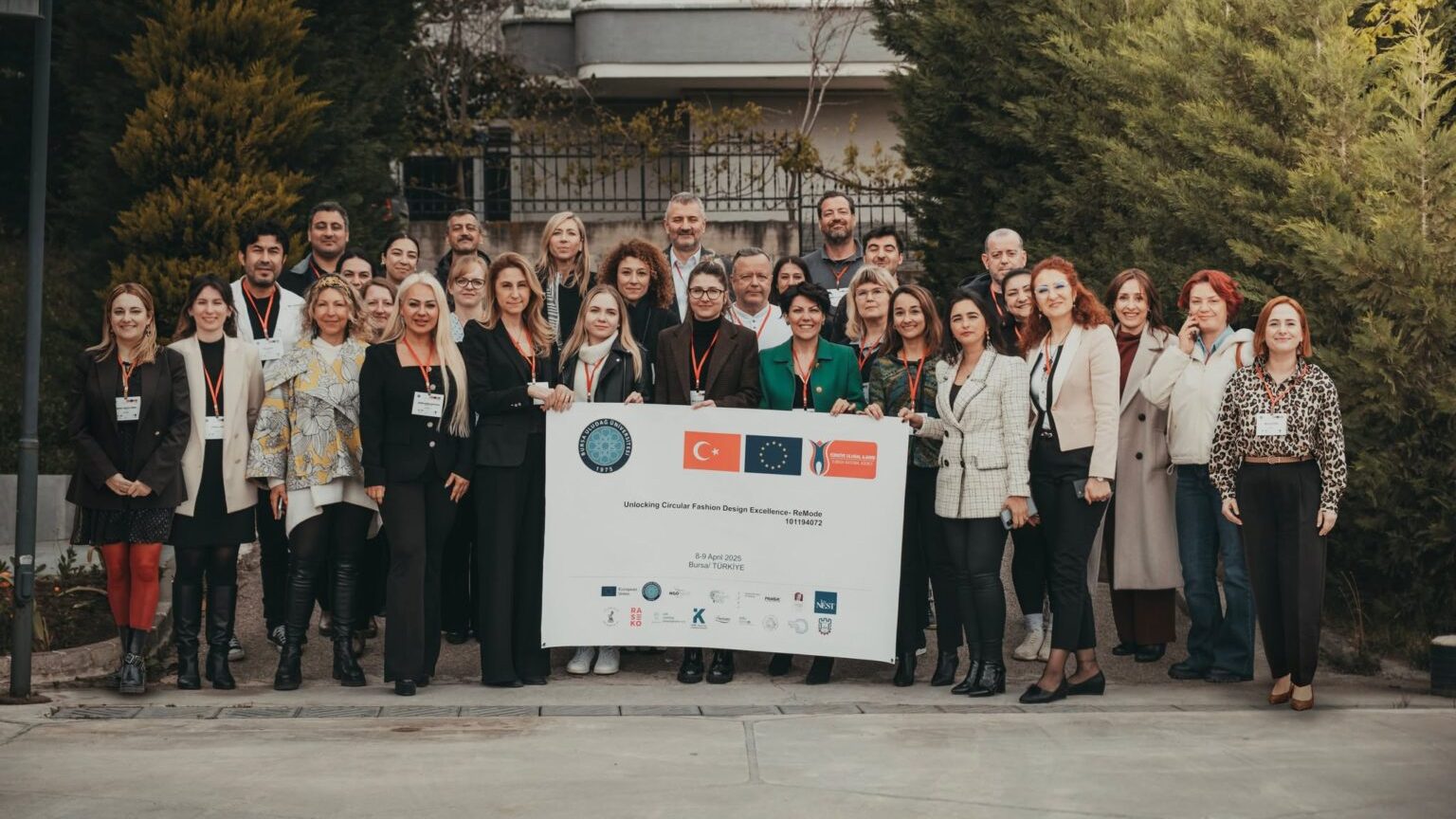
Launched in February 2025 with a €2.63 million grant running through January 2029, ReMODE brings together 17 partners across Turkey, Greece, Italy, Germany, and Finland to establish five Centers of Vocational Excellence (CoVEs). These hubs aren’t just training centers—they’re ecosystems where industry leaders, educators, policymakers, and NGOs collaborate to develop cutting-edge curricula tailored to sustainable fashion’s evolving demands.
At its core, ReMODE tackles fashion’s dual crisis through targeted upskilling and reskilling. The project focuses on identifying future-ready skills for textile professionals, enhancing work-based education’s appeal through experiential learning, and creating comprehensive training pathways that prepare workers for green and digital transitions. By bridging education and industry, ReMODE empowers professionals with the green and digital competencies essential for a circular economy.
ReMODE’s social ripple effects are already visible. The project actively promotes youth employability, women’s empowerment, and social entrepreneurship within the textile sector. NGO Nest Berlin—a key partner—highlights how the initiative creates “new opportunities for young professionals in the fashion world” while addressing systemic issues like poor working conditions endemic to fast fashion.
Through its work-based education approach, ReMODE enhances learning attractiveness by embedding real-world value into training. The project’s WP2 survey on Circular Economy Readiness of SMEs and VET providers demonstrated strong stakeholder engagement, yielding insights that directly shape subsequent phases. Moreover, multidisciplinary collaborations have generated “future‑focused concepts grounded in sustainability and social impact,” proving that ecological responsibility and social equity can advance together.
This aligns perfectly with NGO Nest Berlin’s broader mission as a hub for European projects driving social change—from local community engagement to international partnership facilitation. By upskilling professionals in sustainable practices, ReMODE doesn’t just create jobs; it cultivates changemakers who can redefine industry standards from within.
Environmentally, ReMODE’s potential is transformative. The fast fashion model’s linear “take-make-dispose” approach has fueled ecological crisis—yet circular fashion offers a powerful antidote. By keeping materials in use longer through reuse, repair, and recycling, circular systems dramatically reduce waste, pollution, and resource extraction.
ReMODE directly supports the EU’s Strategy for Sustainable and Circular Textiles, Eco-design Regulation, and Extended Producer Responsibility initiatives—all designed to make fashion’s lifecycle more sustainable. Through its CoVEs, the project develops and disseminates training on circular production, sustainable materials, and digital innovation in fashion. This knowledge transfer is critical: as professionals gain expertise in eco-design and closed-loop systems, they become agents of change capable of reducing the industry’s 1.2 billion tonnes of annual CO₂ emissions—equivalent to more than shipping and aviation combined.
The project’s emphasis on digital innovation further amplifies climate benefits. By integrating technology into training—from AI-assisted design optimization to blockchain-enabled supply chain transparency—ReMODE prepares a workforce that can leverage data-driven solutions for minimal environmental impact.
What makes ReMODE particularly compelling as a case study is its holistic approach. Rather than treating sustainability as an add-on, the project weaves it into the very fabric of vocational excellence. By establishing regional learning hubs that connect education with industry needs, ReMODE creates scalable models for workforce transformation applicable beyond fashion.
For The Social Digest’s readers, ReMODE offers a hopeful narrative: complex systemic challenges like fashion’s environmental toll can be addressed through targeted investment in human capital. When professionals are equipped with circular economy skills and supported by collaborative ecosystems, they don’t just adapt to change—they drive it.
As Europe advances its Green Deal ambitions, initiatives like ReMODE demonstrate that a sustainable future isn’t merely possible—it’s already being stitched together, one skilled professional at a time. The true measure of its success won’t just be in reduced emissions or diverted textile waste, but in the countless individuals who discover that their passion for fashion can coexist with planetary stewardship. That’s the kind of story worth telling—not just in magazines, but in the living labs of vocational classrooms across Europe.